To start a business — and to stay in business and grow — every company has to have a strategy. Some are simple and easily stated, others are complex and take months of careful thought, planning, writing, and rewriting. Some strategies are instantly successful. Others are plagued by underperformance, whether due to a poor economy, ruthless competitors, failure to establish the necessary customer base, or simply poor execution.
Bottom line? Achieving successful outcomes can be a challenge to both new and established businesses.
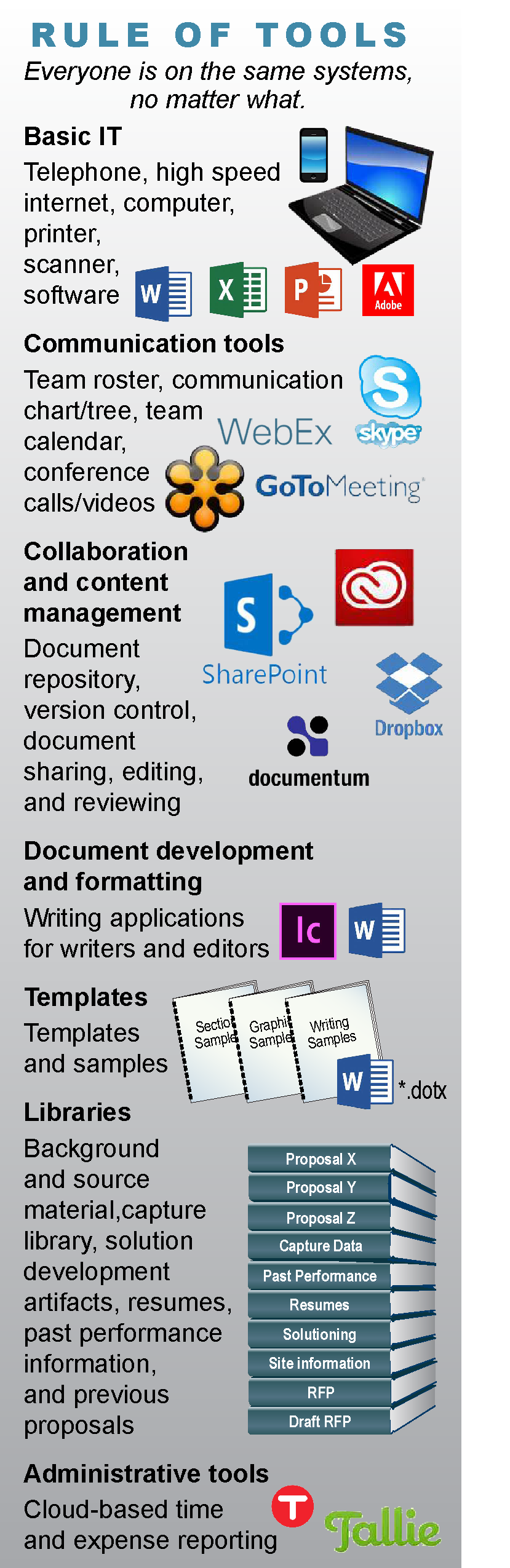
Virtual teams—teams whose members are not physically co-located—perform a wide range of tasks and produce a variety of work products. When your team is virtual, team members may be in different states or even different countries. Members of virtual teams interface electronically instead of face-to-face. Whether your team is working on a project, developing a proposal, or reviewing a document, managing people whom you seldom (or never) see can be challenging. To successfully manage virtual teams, focus on the fundamentals: tools, processes, and people.
Your company has just identified a future program that it wants to win, and you have been named Capture Manager. Congratulations!
Now what?
Your first step, and one of your most important responsibilities as capture manager, is to develop your capture plan. Typically documented in briefing (PowerPoint) form, a well-thought-out capture plan is a living document that will enable informed decision-making at all levels of the organization, throughout the business development process—and increase your probability of winning. Whether you are pursuing Federal, state/local, commercial, or international business, you need a capture plan for every opportunity.
In Part 1, we discussed the importance of the capture plan, and how it is used in decision-making and work products development throughout the capture, proposal, and post-submittal phases. The summary figure at right shows the decision gates and milestones that depend on the information in the capture plan and the ongoing capture activities that continue throughout the business development process, right up to contract award.
Now let’s walk through the three questions that you must answer to develop a good capture plan—one that is complete, useful to the business development/proposal teams, and effective in helping you win.
Proposal reviews are critical to writing a winning proposal and difficult to do well. Review teams must be correctly staffed, well organized, and carefully managed to help the writing team improve the proposal’s evaluation score. This paper discusses the standard color review teams; identifies characteristics of good color review teams; and exposes key pitfalls to avoid in staffing, preparing, and conducting successful color team reviews.
Congratulations, you are a project manager! You have the best job in the world, and one of the hardest. Whether this is a new contract and you are the first project manager, or it is existing work and you must conduct a transition, an effective start-up strategy will lay the foundation for success over the entire project life. Why not take advantage of the experience of other project managers? At XPRT we have managed dozens of projects/programs for U.S. federal government, state governments, commercial, and international customers, and for development and services projects. Our domain knowledge includes such diverse projects as: manufacturing weapon systems; remediating nuclear waste sites; developing, maintaining, and modernizing IT systems; and integrating multiple operations following mergers and acquisitions.